Stroop Effect: What It Is, Why It Happens, and How to See It Yourself
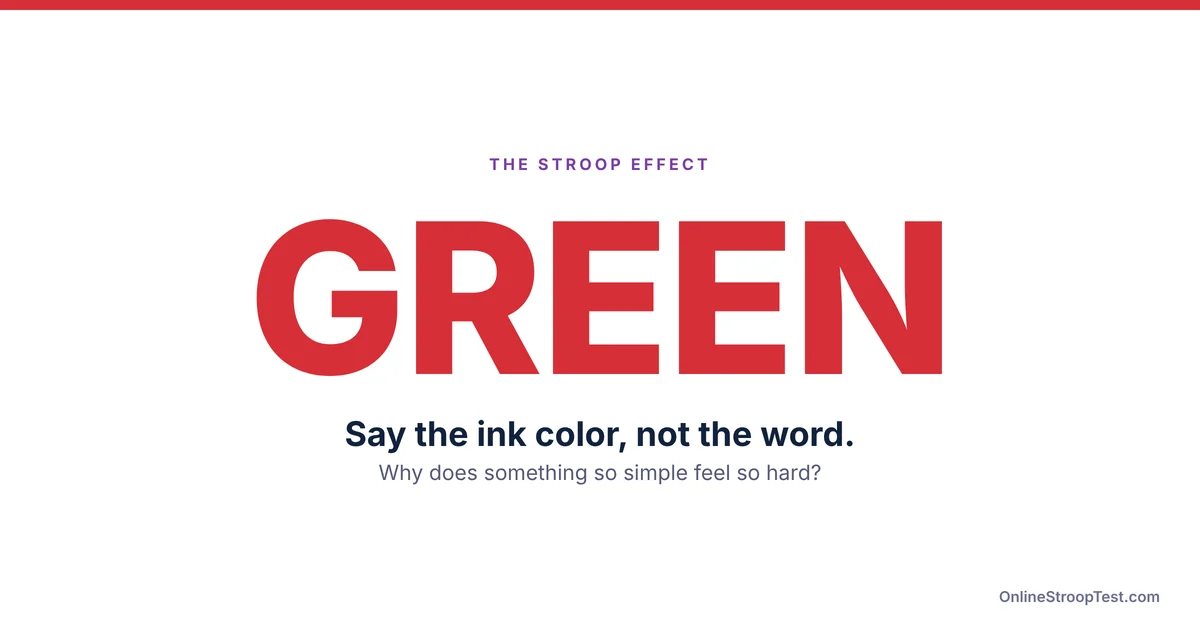
Picture the word GREEN printed in red ink. Your job is simple: say the color of the ink out loud. Most people hesitate for a beat, or catch themselves starting to say “green” before correcting to “red.”
That small stumble has a name. It is the Stroop effect, and it has shown up in psychology labs, classrooms and online tests for almost a century.
What is the Stroop effect?
The Stroop effect is the slowdown, and the extra errors, you get when you have to name the ink color of a word that spells a different color.
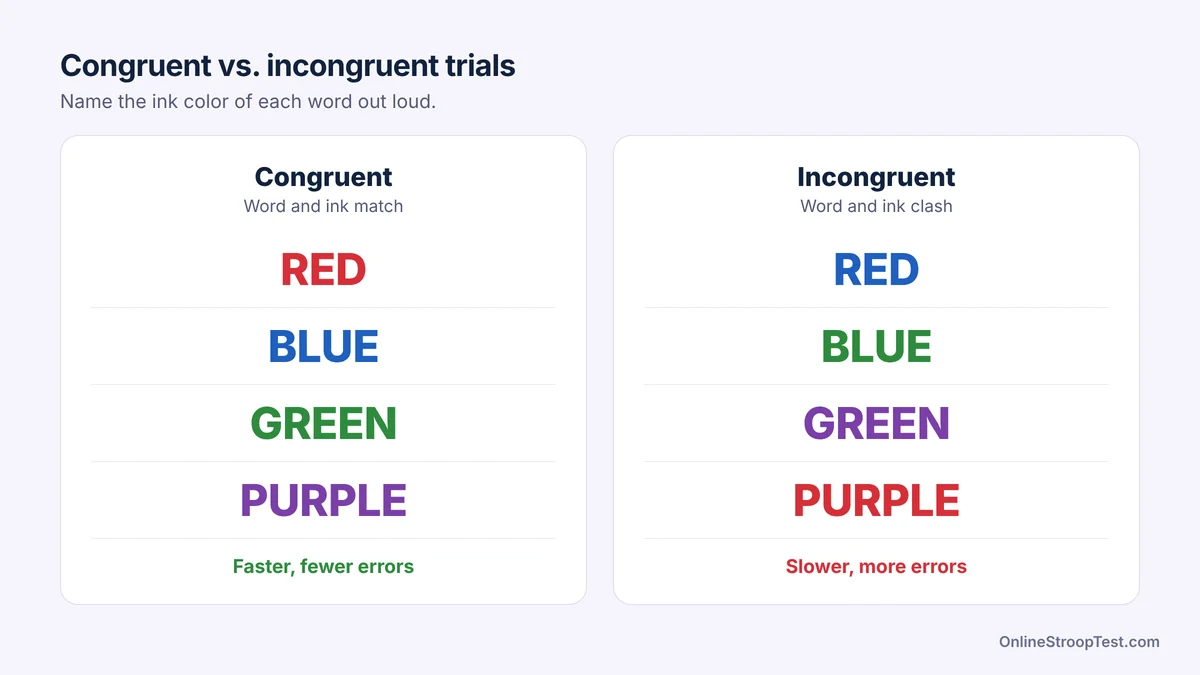
When the word and the ink agree, such as RED printed in red, people answer quickly. When they clash, such as RED printed in blue, answers get slower and mistakes creep in. Researchers call the matching trials congruent and the clashing ones incongruent. The gap between the two average reaction times is the interference effect, and it is the number most Stroop tests report.
How Stroop’s original experiment worked
John Ridley Stroop published the study in 1935 in the Journal of Experimental Psychology, under the title “Studies of Interference in Serial Verbal Reactions.” He was not starting from nothing. James McKeen Cattell had already shown in 1886 that naming colors takes longer than reading words, and a similar conflict effect had been reported in Germany in 1929. What Stroop did was test the idea cleanly and in a way that other researchers could repeat.
His paper had three experiments:
- Reading words. Participants read color names printed in black ink, then the same names printed in clashing colors. Reading barely changed. Ink color did very little to disturb reading.
- Naming colors. Participants named the color of plain squares, then the ink color of words that spelled a different color. On sheets of 100 items, naming the squares took about 63 seconds. Naming the ink of clashing words took about 110 seconds, roughly 47 seconds longer.
- Practice. The third experiment looked at how performance changed with practice.
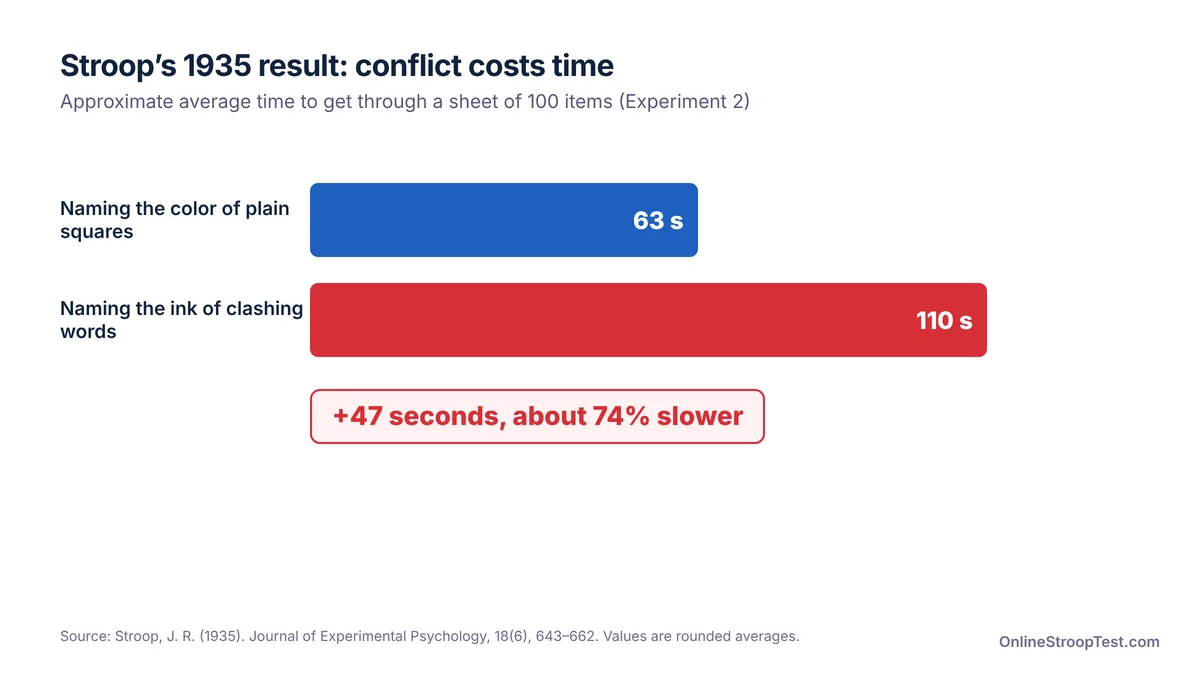
The lopsidedness is the interesting part. Words push hard on color naming, but colors barely push on reading.
Why does the Stroop effect happen?
The most common explanation is automaticity. If you read fluently, reading a word is not something you decide to do. It just happens. Naming a color is slower and takes more deliberate effort. So when a word and an ink color disagree, two responses compete: the fast automatic one (read the word) and the slower intended one (name the ink). Your brain has to resolve that conflict before you can answer, and the resolving takes time.
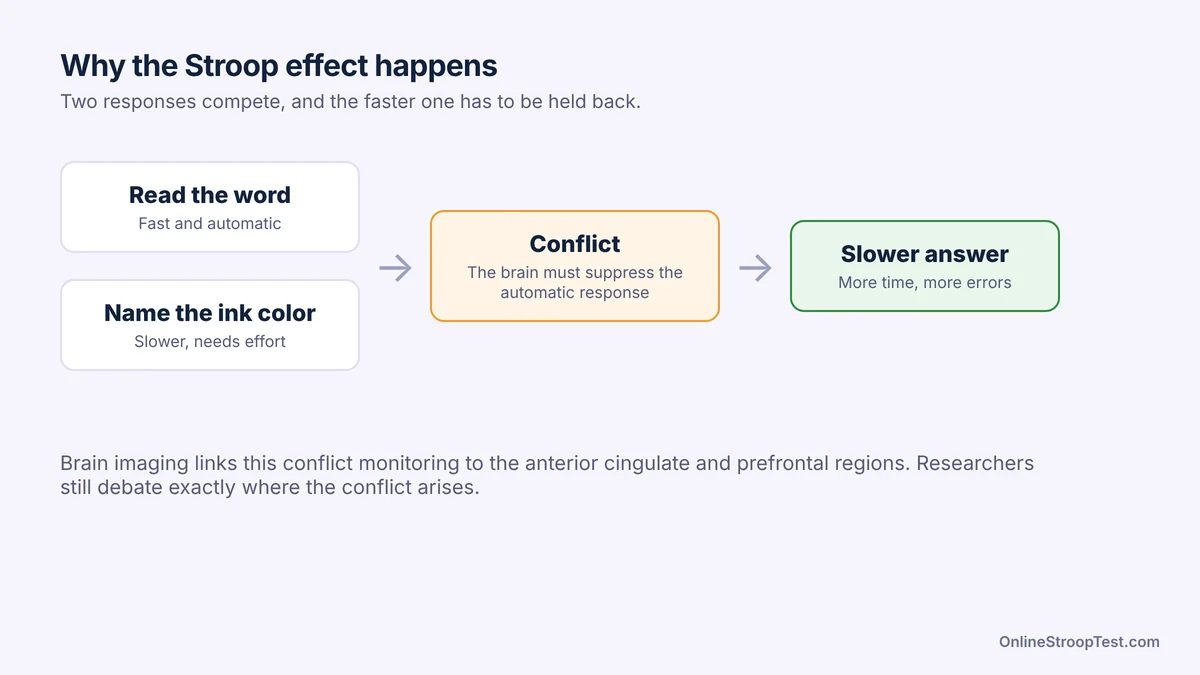
Brain imaging studies have linked this kind of conflict monitoring to the anterior cingulate cortex and to prefrontal regions that help control attention. Researchers still argue about where exactly in the chain the conflict arises. Some point to attention and task set, others to word meaning, others to the moment of choosing a response. The effect itself is rock solid. The full explanation is not settled.
Variations on the Stroop effect
Once the basic idea was clear, researchers adapted it in many directions.
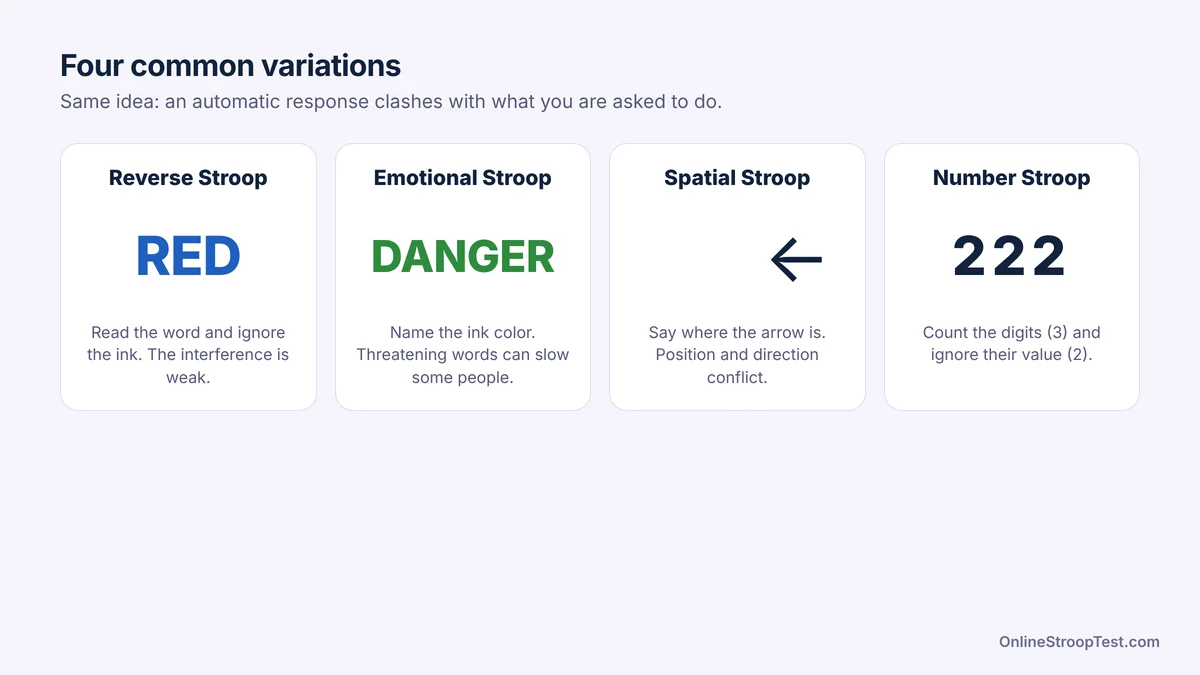
- Reverse Stroop: you read the word and ignore the ink. The interference is weak, which fits Stroop’s original finding.
- Emotional Stroop: you name the ink color of emotionally loaded words. Researchers use it to study how attention is pulled toward things that worry a person.
- Spatial and number versions: an arrow or a number conflicts with its position or its size instead of its color.
- Bilingual versions: the word is in a second language. The effect usually shrinks when the language is less fluent, because the word is less automatic.
Everyday echoes of the Stroop effect
These are not lab-proven Stroop effects, but they show the same kind of conflict.
- A green stop sign would make drivers hesitate, because the color says “go” and the word says “stop.”
- A red button labeled “Continue” feels off. Good interface design keeps color and label in agreement.
- Packaging that breaks color expectations, such as a purple lemon-flavored drink, slows recognition on a shelf.
What changes your Stroop score
A few things tend to move the numbers:
- Practice. Most people improve over their first few sessions as they learn to focus on the ink. Interference usually shrinks, but it rarely disappears.
- Age. Older adults tend to show larger interference than younger adults.
- Fatigue and stress. Tired or stressed people are often slower on incongruent trials.
- Reading fluency and language. The more automatic the reading, the stronger the effect.
- Device. A keyboard and a phone give different timings, so compare scores on the same setup.
Stroop effect vs. Stroop test
The Stroop effect is the phenomenon: the slowdown on clashing trials. A Stroop test is a task built to measure it. Clinicians use standardized, professionally administered versions as one piece of a larger assessment. A free online test is a way to see the effect for yourself, not a diagnosis. Results depend on age, sleep, language and device.
Frequently asked questions
Does the Stroop effect measure intelligence?
No. It reflects selective attention and how automatic your reading is. It is not an IQ test.
Can you train the Stroop effect away?
Practice reduces it, sometimes a lot, but most people still respond slower on clashing trials.
Why is naming the color harder than reading the word?
For fluent readers, reading is automatic and color naming is not. The faster process wins the race unless you actively hold it back.
How long does a Stroop test take?
Our free online version takes 30 seconds for practice, 60 seconds for the standard session, or 3 minutes for the challenge mode.
See the Stroop effect for yourself
The quickest way to understand it is to feel it. Take the free online Stroop test and look at your interference score, accuracy and reaction times.
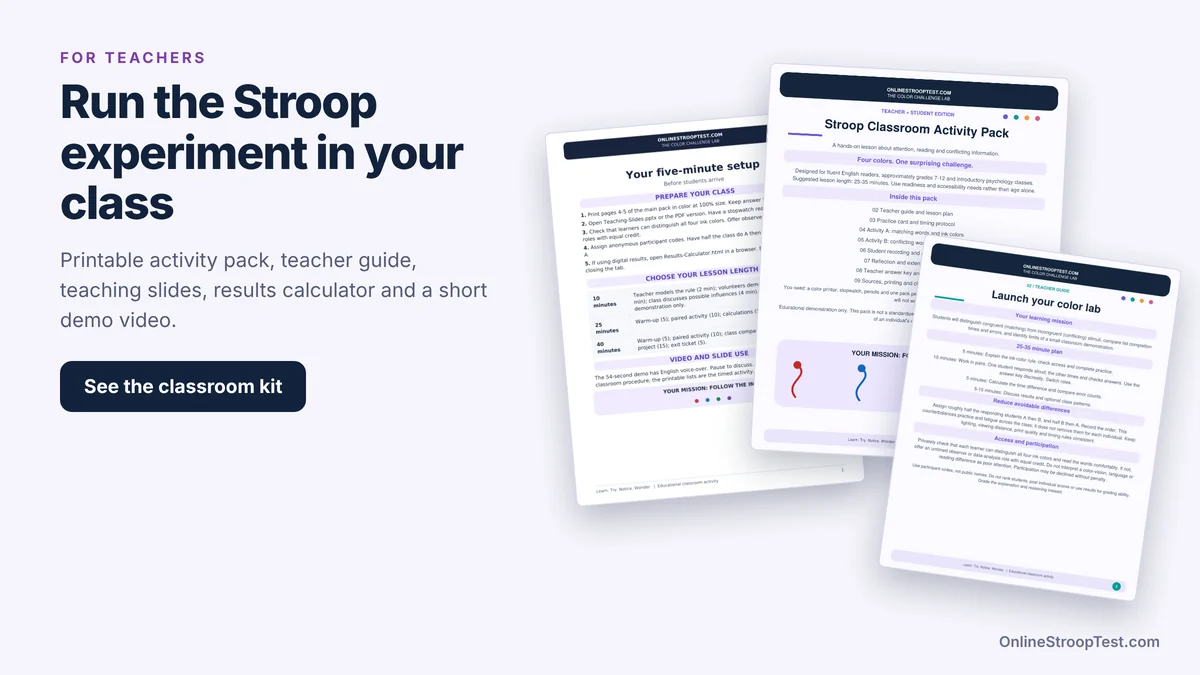
If you teach, our classroom kit has a printable activity, slides and a results calculator so a whole class can run the experiment (see the classroom kit).
Sources
- Stroop, J. R. (1935). Studies of interference in serial verbal reactions. Journal of Experimental Psychology, 18(6), 643-662. https://doi.org/10.1037/h0054651
- MacLeod, C. M. (1991). Half a century of research on the Stroop effect: An integrative review. Psychological Bulletin, 109(2), 163-203. https://doi.org/10.1037/0033-2909.109.2.163
- Parris, B. A., Augustinova, M., & Ferrand, L. (2019). Editorial: The locus of the Stroop effect. Frontiers in Psychology, 10, 2860. https://doi.org/10.3389/fpsyg.2019.02860